
February 2026 | Textile Recycling Blog
How to Price Textile Waste Feedstock for Recycling
A Practical Guide for Sellers

Content:
- Why is it important to talk about pricing
- The Pricing Problem in Textile Recycling
- Why There Is No “Market Price”
- How Recyclers Calculate Value: The Fibre Proximity Principle
- The Role of Traders (And Where Things Go Wrong)
- A Step-by-Step Pricing Framework for Sellers
- Step 1: Define Your Specification Clearly
- Step 2: Understand Your Position in the Value Chain
- Step 3: Separate Material Value from Logistics
- Step 4: Improve What You Can Control
- What To Do If You’re Still Unsure About Your Price
- 10 Questions Every Seller Should Ask a Buyer
- Red Flags to Watch For
- How Transparency Can Unlock Scale
- Final Thought: Building a Transparent Market
The textile recycling industry speaks constantly about innovation, fibre-to-fibre breakthroughs, and ambitious circularity targets. Yet very few conversations address the uncomfortable topic of pricing.
Suppliers — collectors, aggregators, and factory waste handlers — are often left guessing what their material is truly worth, whether they are being underpaid, and why pricing feels inconsistent from one deal to the next.
This guide is written for sellers.
Because if suppliers cannot price their feedstock with clarity and confidence, the entire recycling system is destined to fail.
1. Why is it important to talk about pricing
At Eslando, we work with both buyers and sellers of textile waste, and our goal is simple: to grow the textile recycling industry as a whole. But there is a growing “dream gap” in the system.
Today, brands are promised circularity, investors are promised scale, governments are promised recycling targets, and recyclers raise funding on innovation stories.
Yet suppliers — collectors, aggregators, and waste handlers — are often treated like commodity traders. They are rarely shown the true economics of the value chain or included in long-term purchasing commitments.
If suppliers cannot see economic upside, they will not invest in better segregation and higher-quality feedstock. And without better segregation, fibre-to-fibre recycling cannot scale.
Poor pricing structures are one of the hidden bottlenecks preventing circular textiles from reaching true scale.
2. The Pricing Problem in Textile Recycling
Unlike metals, paper, or PET bottles, textile waste does not have a transparent commodity index. There is no daily “polyester yarn scrap index” you can check.
Instead, pricing is negotiated privately, shaped by relationships, heavily dependent on quality, and often influenced by information asymmetry. In many transactions, the party with downstream visibility — typically the recycler or trader — holds greater pricing power than the supplier.
That imbalance creates confusion, inconsistent pricing, and, over time, mistrust within the value chain.
That imbalance creates confusion — and sometimes mistrust.
3. Why There Is No “Market Price”
Let’s be clear:
There is no single “market price” for textile feedstock because textile waste is not one uniform product.
Even within polyester waste alone, there can be 100% white yarn waste, mixed coloured fabric scrap, densified agglomerate, dope-dyed material, or blended textiles. Each varies in fibre purity, contamination levels, yield loss during recycling, processing complexity, and ultimate end-product value.
Two shipments both labelled “polyester waste” can have completely different economic outcomes for a recycler. That is why pricing varies — not necessarily because someone is being unfair, but because the underlying material is different.
It is also not the buyer’s responsibility to educate every supplier on recycling economics. Buyers price based on their technology, cost structure, and output markets. For suppliers to negotiate effectively, they must understand these variables themselves.
So when someone refers to a “market price,” the real question should be: market price for which specification?
4. How Recyclers Calculate Value: The Fibre Proximity Principle
Most recyclers operate using a version of this simplified logic:
Feedstock Price = Output Value – Processing Cost – Yield Loss – Logistics – Risk Margin
But rather than memorising the formula, it is easier to understand the core principle:
The less work required to return your material to pure, usable fibre, the more a recycler can afford to pay.
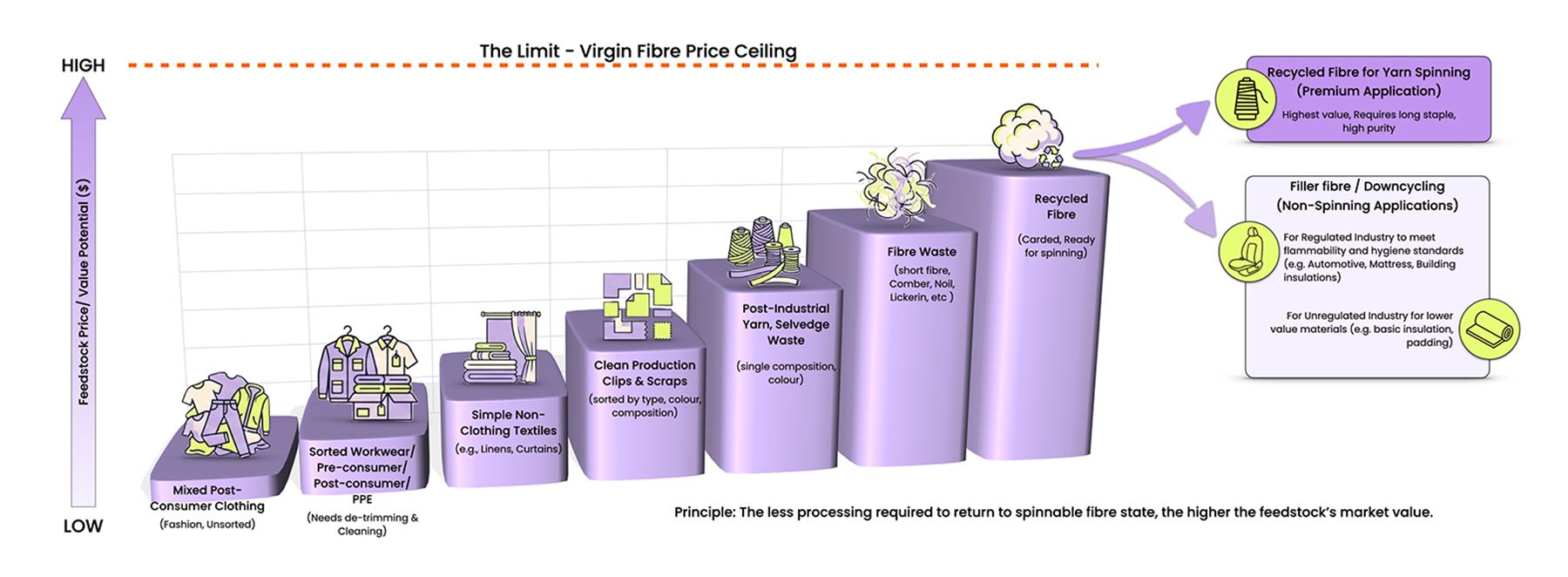
At Eslando, we call this fibre proximity.
The closer your feedstock is to becoming spinnable fibre — in purity, consistency, and cleanliness — the higher its economic value.
If your material is single composition, colour-consistent, low contamination, and requires minimal reprocessing, you sit higher on the value curve. If it requires heavy de-trimming, blending correction, or produces high residue, you sit lower.
There is also an important ceiling.
Your maximum price is anchored to the price of virgin fibre. If recycling your waste costs more than buying brand-new polyester or cotton, most buyers will choose virgin material. This is not ideology — it is industrial economics.
Because virgin fibre sets your economic ceiling, suppliers should regularly monitor raw material markets. Useful reference points include:
- Polyester by Emerging Textiles (requires paid access)
- Cotton by Business Insider
These markets fluctuate — and when virgin prices move, recycled feedstock prices will follow.
a. Why This Chart Is Built Around Open-End Spinners (Mechanical Recyclers)
The value curve presented here reflects the economics of Open-End spinners (mechanical recyclers), who dominate recycled fibre demand globally.
Open-End spinning requires:
- Adequate fibre length
- High purity
- Cleanliness
- Moisture control
This makes “distance to spinnable fibre” a useful and globally relevant benchmark.
Other technologies — thermo-mechanical recycling, chemical depolymerisation, enzymatic recycling — operate differently. As those markets mature and standardise, alternative pricing models may emerge. For now, mechanical recycling provides the most grounded global reference point.
b. The Filler Fork: Understanding the Compliance Premium
Not all material reaches yarn spinning. When feedstock does not meet fibre length or purity requirements, it reaches what we call the Filler Fork — where its value depends entirely on which industry it enters.
In regulated industries such as mattresses, furniture, automotive interiors, and certain building applications, strict flammability and hygiene standards apply. Here, buyers are not only paying for fibre — they are paying for compliance. If your material is documented, traceable, consistent, and meets contamination thresholds, it can access these markets and command a higher filler price. This is the compliance premium.
In contrast, unregulated markets — such as basic insulation or low-grade padding — have lower technical requirements and lower pricing ceilings. They function as a safety net for lower-grade waste, but because barriers are minimal, so is the value.
c. How You Could Increase the Value: Moving Up the Curve
For sellers, the opportunity to increase value lies in transparency and control. When you can clearly demonstrate fibre composition, cleanliness, moisture levels, and consistent supply, your material shifts from “uncertain waste” to a verified industrial input. That shift directly changes how buyers assess risk. And in industrial markets, lower risk almost always translates into higher price. The more confidence you create around your feedstock, the further up the value curve you move
5. The Role of Traders (And Where Things Go Wrong)
Intermediaries or traders are not the enemy. At Esland,o we welcome traders to our marketplace with open arms.
Aggregation, Credit line, logistics coordination, and market access are very valuable services!!
But problems arise when:
- Buyers do not disclose whether they are end recyclers or traders
- Material is price-shopped without transparency
- Suppliers are pressured to reduce prices without clear justification
- The downstream economics remain hidden
When suppliers cannot see how value is created further along the chain, they cannot make informed decisions about segregation, investment, or long-term partnerships. Opacity may createa short-term margin, but over time it erodes trust and weakens material quality. And without consistent quality, fibre-to-fibre recycling cannot scale.
6. A Step-by-Step Pricing Framework for Sellers
Here’s a practical way to think about pricing your feedstock.
a. Step 1: Define Your Specification Clearly
Before you negotiate price, define:
- Fibre composition (%)
- Colour consistency
- Contamination level
- Moisture content
- Form (loose, baled, densified)
- Source (post-industrial or post-consumer)
- Monthly volume consistency
If you cannot describe your material clearly, you cannot defend your price.
Structured marketplaces like Eslando are designed to guide sellers through defining these specifications clearly — reducing ambiguity before negotiations even begin.
b. Step 2: Understand Your Position in the Value Chain
Ask yourself:
- Is my material directly recyclable, or does it require heavy de-trimming, sorting?
- Is it mono-material or blended?
- Is it consistent every month?
- Does it reduce yield loss for recyclers?
Higher consistency = lower risk = higher potential price.
c. Step 3: Separate Material Value from Logistics
Clarify pricing terms:
- Ex-Works (EXW)?
- Delivered?
- FOB?
- CIF?
A higher delivered price may hide high logistics costs.
Always separate:
Material value from transport cost. Therefore, at the Eslando marketplace, we ask sellers for Ex-Work pricing rather than delivered pricing.
d. Step 4: Improve What You Can Control
If you want to increase the price, focus on:
- Better segregation
- Removing trims and non-textile elements (manually or automatically)
- Colour sorting
- Providing test reports
- Offering consistent monthly volumes
Quality improvements justify price increases.
If buyers don’t reward quality improvements, reconsider the partnership.
On Eslando, verified sellers receive structured feedback on how to improve feedstock value and positioning within the market.
7. What To Do If You’re Still Unsure About Your Price
It’s completely normal to feel unsure about how to price your feedstock. The goal is not to guess — it’s to calculate.
Start by working backwards from your own costs.
Ask yourself:
- How much does it cost you to acquire the material (per kg or per tonne)?
- What are your overheads allocated per tonne (labour, storage, utilities, finance)?
- How much does sorting cost to achieve a single, uniform grade?
- What does baling, packing, and preparation cost?
- What profit margin do you want to make?
Once you calculate these, you will have your minimum viable selling price — the number below which you should not trade.
Textile recycling is a B2B, volume-driven industry. It typically operates on lower margins but higher tonnage. That means:
- A small margin on 200 tonnes is still meaningful.
- You could also make a tier-based pricing – for e.g. 100 tonnes – x pricing. For 100-999 tonnes 3% discount. For 1000-2000 tonnes 10% discount and so on.
- A very high margin may price you out of long-term contracts.
- A very low margin may not be sustainable.
The key is balance. Leave room for the next partner in the value chain to operate profitably as well.
Final Check Before You Quote
Once you reach a number, sense-check it against two principles:
- Fibre proximity — How close is your material to spinnable, usable fibre?
- The virgin ceiling — Your price cannot exceed what makes economic sense compared to virgin material.
If you’re still unsure, get your stock reviewed by Eslando (only available to Eslando customers). A second opinion grounded in market logic can prevent underpricing — or overpricing — your material.
8. Ten Questions Every Seller Should Ask a Buyer
- Are you the end recycler or an intermediary?
- What recycling technology do you use?
- What level of contamination is acceptable?
- What yield loss do you typically experience?
- What fibre purity do you require?
- Who pays for logistics?
- What documentation do you need from me?
- What are your payment terms?
- Is this a one-off deal or recurring volume?
- How do you determine pricing?
You may not get detailed answers every time.
But asking these questions changes the dynamic.
It signals professionalism.
9. Red Flags to Watch For
Be cautious if:
- The buyer refuses to clarify their role.
- Pricing changes frequently without explanation.
- Payment terms are vague.
- There is no written agreement.
- The buyer insists on the lowest price without discussing quality.
- There is no feedback loop on material performance.
If pricing conversations feel one-sided, they probably are.
10. How Transparency Can Unlock Scale
The industry often focuses on technology. But pricing transparency is just as critical.
When suppliers understand how value is calculated, are rewarded for quality improvements, and have predictable offtake, they invest in better segregation, cleaner storage, and long-term supply commitments.
Recyclers cannot only sell the circular dream to brands and investors. They must make the economics visible to suppliers as well.
Without aligned incentives, circularity risks remaining a marketing narrative rather than an industrial reality.
11. Final Thought: Building a Transparent Market
Pricing textile feedstock is not about extracting the highest possible price. It is about understanding value, reducing uncertainty, and aligning incentives across the value chain.
The future of textile recycling will not be built on fragmented negotiations and hidden margins. It will be built on structured trade, defined specifications, and transparent economics.
At Eslando, we are building a marketplace where buyers and sellers commit to clarity — in specifications, in pricing logic, and in commercial expectations.
If you are serious about trading textile feedstock transparently — whether as a supplier, recycler, or trader — we invite you to join the Eslando marketplace and be part of building a more structured recycling economy.
Because circularity will only scale when the economics are visible to everyone involved.